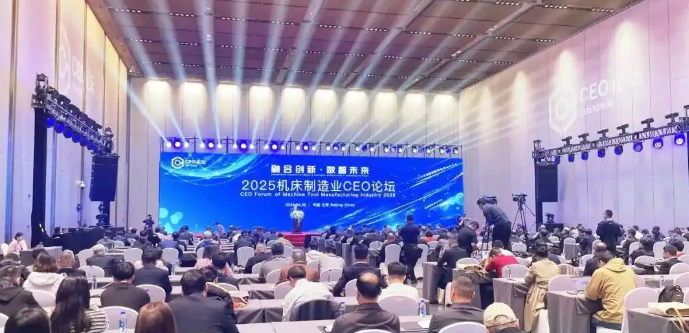
On April 20, 2025, the “2025 Machine Tool Manufacturing CEO Forum” hosted by the China Machine Tool Industry Association was successfully held at the Shunyi Capital International Convention Center in Beijing. As an important supporting and warm-up activity of the 19th China International Machine Tool Exhibition (CIMT2025), the forum invited the heads of industry associations from the United States, Italy, Japan, Switzerland, Germany and other countries, as well as Taiwan, China, China, to give speeches, attracting more than 200 global machine tool and user enterprise executives, experts, scholars and media representatives. The attending guests engaged in in-depth dialogue on the current operation status, technological trends, market challenges, and cooperation opportunities of the global machine tool industry, injecting new momentum into the future development of the industry. Mao Yufeng, President of China Machine Tool Industry Association, delivered a speech at the forum, and Wang Xu, Vice President, presided over the forum.
Global Machine Tool Market: Recovery and Differentiation Coexist
At the forum, representatives of industry associations from multiple countries (regions) shared data and future prospects of the machine tool market in 2024. Data shows that the global machine tool industry has shown a trend of differentiation and recovery after experiencing short-term fluctuations.
The US market is significantly affected by economic fluctuations. Douglas K. Wu, President of the American Machinery Manufacturing Technology Association (AMT), stated that the machine tool output value will be 7.059 billion US dollars in 2024, a year-on-year decrease of 13%; The consumption amount was 11.828 billion US dollars, a decrease of 8%. Despite a 3.8% decline in orders throughout the year, orders continued to grow in the three months ending the year (November+12.4%, December+5.4%, January 2025+5.7%). The strong demand in fields such as aerospace, semiconductors, and new energy has become the main driving force, with key technologies focusing on advanced automation, digital twins, artificial intelligence, and other directions.
The trade of Sino Italian machine tools has fluctuated in both directions, and exports to China have continued to decline in recent years. Mr. Peng Sabin, the Italian Trade Coordinator in China, stated that Italy’s exports to China will decrease by 13.1% annually in 2024, and China’s exports to Italy will also shrink. Although the Italian machine tool industry maintains a leading position in the European Union, bilateral trade between China and Italy faces challenges, especially with weak growth in Italy’s exports to China. China’s machine tool exports are showing diversified growth, with significant growth rates in emerging markets such as Southeast Asia and South America. Both China and Italy need to strengthen cooperation to address structural trade imbalances.
The Japanese market is optimistic about expectations. The President of the Japan Machine Tool Manufacturers Association (JMTBA), Yoshiharu Inaba, believes that the total machine tool orders in Japan in 2024 will be 148.51 billion yen, which is basically the same as in 2023. Among them, domestic demand increased by 7.4% (44.15 billion yen), and exports accounted for 70% (104.36 billion yen). Although demand in the semiconductor and automotive industries has not fully recovered, investment in aircraft and artificial intelligence related equipment in Japan has injected vitality into the market. The Japan Machine Tool Industry Association predicts that the industry will gradually recover in the second half of 2025, and the annual output value is expected to reach 1.6 trillion yen, a year-on-year increase of 8.8%.
The Swiss market has experienced a significant decline. Affected by the risk of global economic recession, Swiss machine tool production and exports will decrease by 21% and 12% respectively in 2024, with major export markets such as Germany, China, and the United States experiencing varying degrees of contraction. However, short-term demand in the energy, aerospace, and medical sectors provides support for the industry. Secretary General Christophe Brett of the Swiss Technical Industry Association Machine Tool Manufacturers Department (SWISSMEM) calls for strengthening free trade cooperation to address the challenges of supply chain volatility.
The orders in the German market have shrunk. As the world’s second largest machine tool manufacturer (with a production of 10.2 billion euros in 2024) and the largest exporter (with an export value of 7.7 billion euros), Germany is facing pressure from a 43% drop in Chinese demand and a 17% decline in domestic orders. Dr. Song Na, China affairs expert at the German Machine Tool Manufacturers Association (VDW), pointed out in her speech that the industry needs to accelerate its transformation towards “regional production” while consolidating its core competitiveness in cutting technology and services.
China’s role: the “stabilizer” and “innovation field” of the global machine tool industry
President Mao Yufeng emphasized in his opening speech that China, as the world’s largest consumer (32.5%) and producer (32.1%) of machine tools, has become a key force driving industry development. In 2024, the added value of China’s manufacturing industry reached 34 trillion yuan, ranking first in the world for more than ten consecutive years, providing a huge application scenario for the machine tool industry.
Mao Yufeng pointed out that China is accelerating the green and digital upgrading of its manufacturing industry through policies of “two new” (equipment updates and consumer goods trade in) and “two new” (national major strategic implementation and key area security capacity building projects). The demand for high-end machine tools in emerging industries such as new energy vehicles, aerospace, and semiconductors continues to rise, attracting international giants such as DMG Precision Machinery, Yamazaki Mazak, and Tongkuai to increase their investment in China. These enterprises not only regard China as an important market, but also as a strategic pivot for technological iteration and global competition.
Mao Yufeng stated that China will continue to promote high-level opening up to the outside world, providing a stable policy environment and broad market space for global machine tool enterprises.
Coping with Uncertainty: Global Collaboration under the Reshaping of Machine Tool Supply Chain
The speaker also focused on the common challenges faced by the global machine tool industry. In order to cope with uncertainty, the machine tool supply chain needs to reshape global cooperation: geopolitical and trade barriers, cost and zero carbon target games, bottlenecks in rapid talent and technology development, and new market expansion issues urgently need to be addressed.
In terms of geopolitics and trade barriers, the US China science and technology war, the Russia-Ukraine conflict, and the Red Sea shipping crisis have exacerbated the uncertainty of the supply chain. Zhuang Dali, president of the Taiwan, China Machinery Industry Association, pointed out that Taiwan, China’s machine tool exports are improving their competitiveness by diversifying the market and introducing AI and Internet of Things technologies. German companies are accelerating the “local manufacturing, local sales” model to avoid tariff risks.
In terms of cost and zero carbon, although the net zero carbon emission target has pushed up production costs, representatives from Japan and Germany still call for strengthening the research and development of green machine tool technology, and green machine tools and circular economy models have become new benchmarks in the industry.
In terms of talent and technological bottlenecks, cross disciplinary technologies such as artificial intelligence, advanced materials, and synthetic biology will reshape the machine tool ecosystem. Generative AI optimizes production processes, while digital twin technology enhances equipment efficiency. The shortage of AI and cross disciplinary talents has become a key factor restricting innovation, and most attending company representatives believe that it is necessary to deepen industry university research cooperation.
In terms of market expansion, experts believe that emerging markets such as Mexico and Türkiye have become the focus of the layout, and the return of the US manufacturing industry has brought market growth opportunities.
Chairman Mao Yufeng believes that although the global economy is facing uncertainty, the scale advantage, policy dividends, and innovation vitality of the Chinese market will provide “certainty” for the global machine tool industry. He called on enterprises from all countries to strengthen cooperation, jointly address supply chain, technological, and environmental challenges, and build a new ecosystem of open and win-win industries.
conclusion
The 2025 CEO Forum for Machine Tool Manufacturing not only provides a dialogue platform for global industry leaders, but also outlines the development blueprint of the machine tool industry under the wave of intelligence and globalization. As Vice President Wang Xu said, let’s take today’s gains, enter tomorrow’s exhibition hall, strive for the orders of the day after tomorrow, and achieve future development. With the deep linkage between China and the international market, machine tools, as the “tool of manufacturing”, will continue to be the core engine for upgrading the manufacturing industry, promoting the global industry to move towards an efficient, green, and sustainable future.